
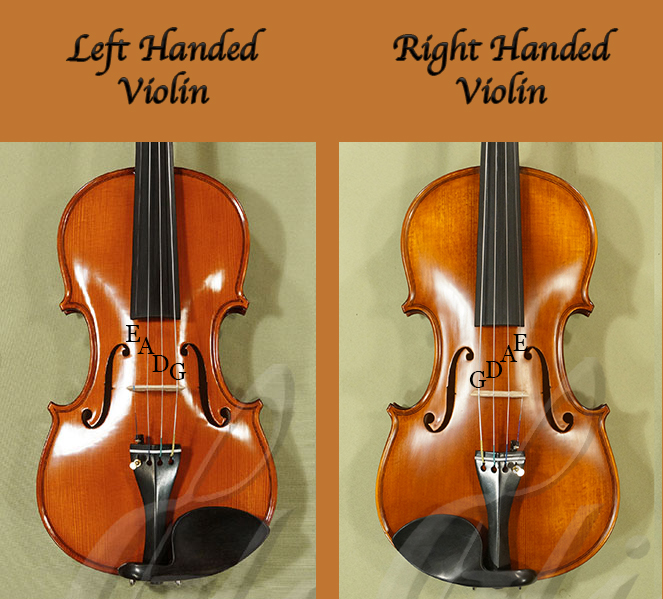
What is a left-handed violin?
- A left-handed violin is a mirror copy of a right-handed violin.
- It is held in the right hand and rests on the right shoulder. The bow is held and coordinated with the left hand.
- A left-handed instrument is designed and built that way from the beginning. Contrary to the general perception, a right-handed violin cannot be converted to a left-handed violin by just placing it on the right shoulder.
What makes a violin left-handed?
There are several construction elements that define a violin built to be played left-handed:
- The bass bar is placed under the right leg of the bridge.
- The sound post is placed under the left leg of the bridge.
- The strings, from the right to left, run G-D-A-E. Consequently, the position of the peg holes needs to be modified to meet the new order of the strings.
- The bridge — as another consequence of the new order of the strings, its shape needs to be adjusted, too.
- The fingerboard is very slightly hollowed along its length, and that hollow is deeper on the G string side than on the E. The G is the thickest string and swings in a wider arc when bowed, so it needs more clearance to avoid buzzing against the board. On a left-handed violin that asymmetry is mirrored along with everything else, so the extra clearance sits under the G in its new position.
- The chin rest is the last element, and probably the most difficult to be made. The chin rest for a left-handed violin is an image in the mirror of the chin rest for a right-handed violin, and it is carved to hold the right side of the chin.
How are left-handed violins different to play?
The most obvious difference is the orientation of the instrument and the way it is held. While the instrument itself is a mirror image of a traditional violin, the lowest string (G) is still positioned closest to the musician's chin and the highest string (E) farthest away. This is made possible by the position of the peg holes in the peg box and the shape of the bridge.
The chin rest and shoulder rest are positioned differently to suit a left-handed player.
Who plays left-handed violins?
Left-handed violins are played by people who prefer to use their left hand for tasks requiring fine motor skills and coordination. Some are born with a natural preference for the left hand; others develop one after an injury or disability affecting the right.
Two well-documented examples:
- Charlie Chaplin. The actor, comedian and filmmaker was also a capable musician who composed many of his own film scores. He played the violin left-handed, with his instruments strung in reverse.
- Rudolf Kolisch. The Austrian-American violinist led several string quartets and taught at Harvard. Following a childhood injury to the middle finger of his left hand, he relearned the violin with the functions of the hands reversed — bowing with the left and fingering with the right.
Can a left-handed person play a right-handed violin?
Yes, definitely — and most do.
On a standard violin the left hand controls finger placement on the fingerboard while the right hand bows. The majority of violinists, left-handed people included, play a standard instrument without modification and find it suits them perfectly well. It also gives them access to a far wider range of instruments, teachers and learning materials.
Choosing a left-handed violin is a matter of personal comfort rather than necessity. It is worth discussing with your teacher before you decide.
Why do people play left-handed violins?
- Comfort. For some left-handed people, playing left-handed simply feels natural. They find they can be more expressive, and that their body absorbs instruction more easily when it isn't fighting itself.
- After an injury. Someone who has injured their left shoulder cannot hold a violin there for long, and repetitive strain may make it worse. Moving the instrument to the right shoulder can offer a second chance at playing.
- Challenge. Occasionally someone chooses it simply to try something different. This is rare — in all my years I have met exactly one person who did.
What are the challenges of playing a violin left-handed?
- Availability. Left-handed violins are rare compared with standard instruments. A good one can be hard to find, and the selection is limited.
- Finding a teacher. Not every teacher will agree to take on a student who wants to play left-handed.
- Fewer choices. You may have to compromise on preferences you would not have to compromise on with a standard violin.
- Ensemble playing. In an orchestra or quartet, a left-handed player bows in the opposite direction to everyone around them, which affects seating and alignment.
Are there left-handed violas?
Yes, though they are rarer still than left-handed violins, and we do not keep them in stock — the demand simply isn't there.
We can make one for you. Left-handed violas are built to order at the Gliga workshop in Romania, the same place our violins are made, with a typical manufacturing time of two to three months. If you play viola and want a left-handed instrument, email us and we will take it from there.
Where can you buy a left-handed violin in Canada?
Left-handed violins are not widely available, but they are not impossible to find either. Gliga began making them in the early 2000s, and is probably among the first contemporary makers to do so in response to demand. The left-handed violins we currently have in stock are listed above on this page.
If you are a left-handed person who wants to play the violin, you can play either a traditional or a left-handed instrument. If you believe a left-handed violin will make your musical journey more enjoyable, we would be happy to help you find the right one.