

Product Description
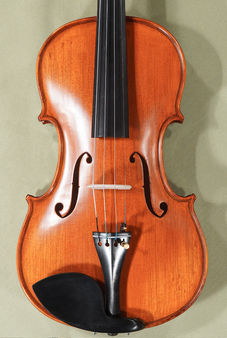
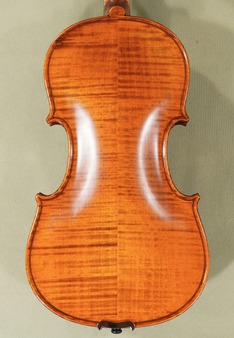
Gliga Maestro Violin — Inspired by Stradivari’s 1679 “Hellier” - Code D1805V
The Hellier is the finest of the decorated violins Stradivari made — and the one he kept for fifty-five years before he would sell it.
| Gliga Maestro Violin — Inspired by Stradivari’s 1679 “Hellier” - Code D1805V | |
| Other details: | |
| Code: | D1805V |
| Size: | 4/4 |
| Top: | Solid Carpathian Spruce |
| Back: | Solid Carpathian Flamed Maple |
| Sides: | Solid Carpathian Flamed Maple |
| Neck: | Solid Carpathian Flamed Maple |
| Accessories: | Ebony |
| Pattern: | Stradivari |
| Purfling Type: | Ebony and Maple - Manually Inlaid Purfling |
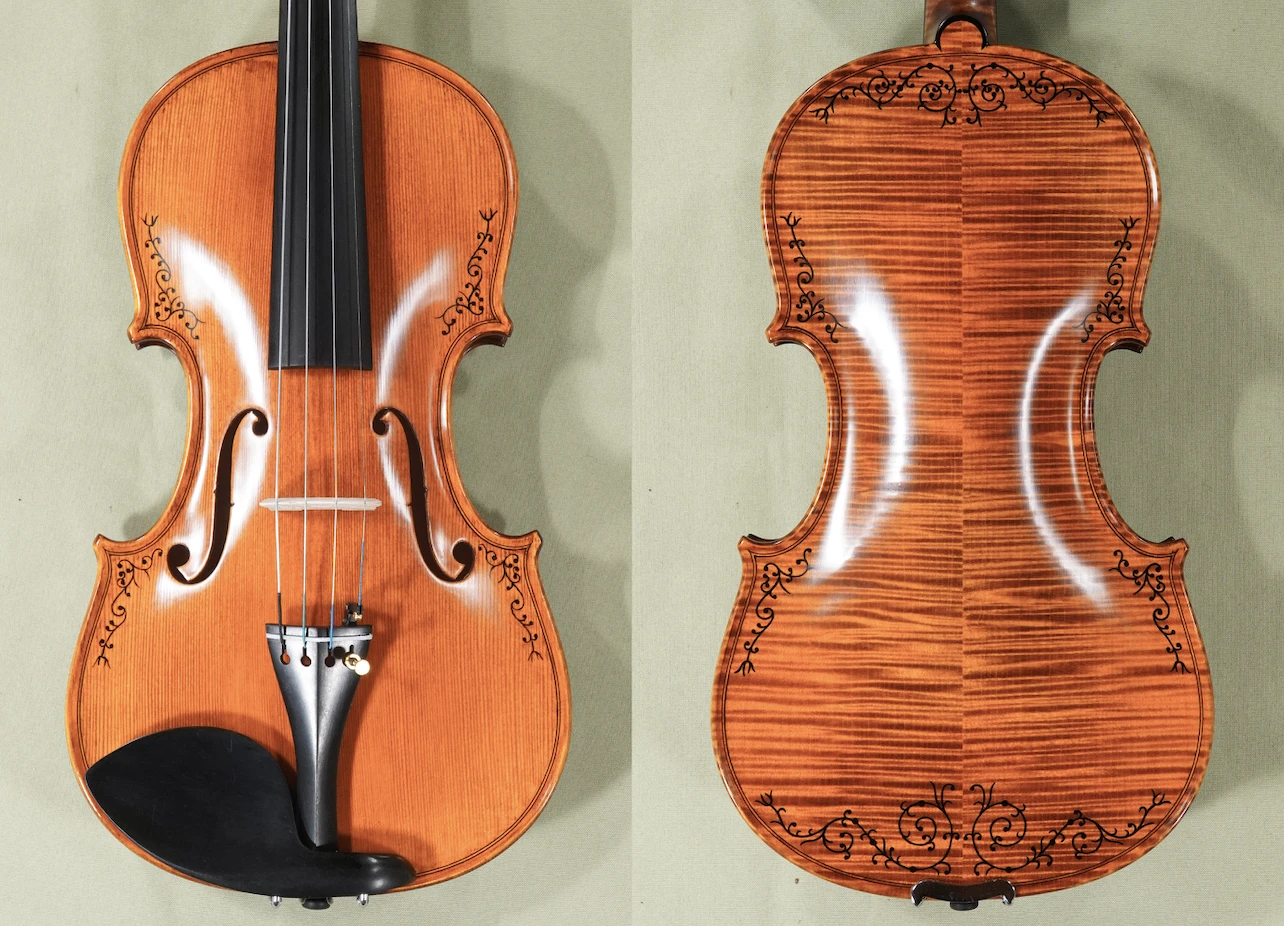
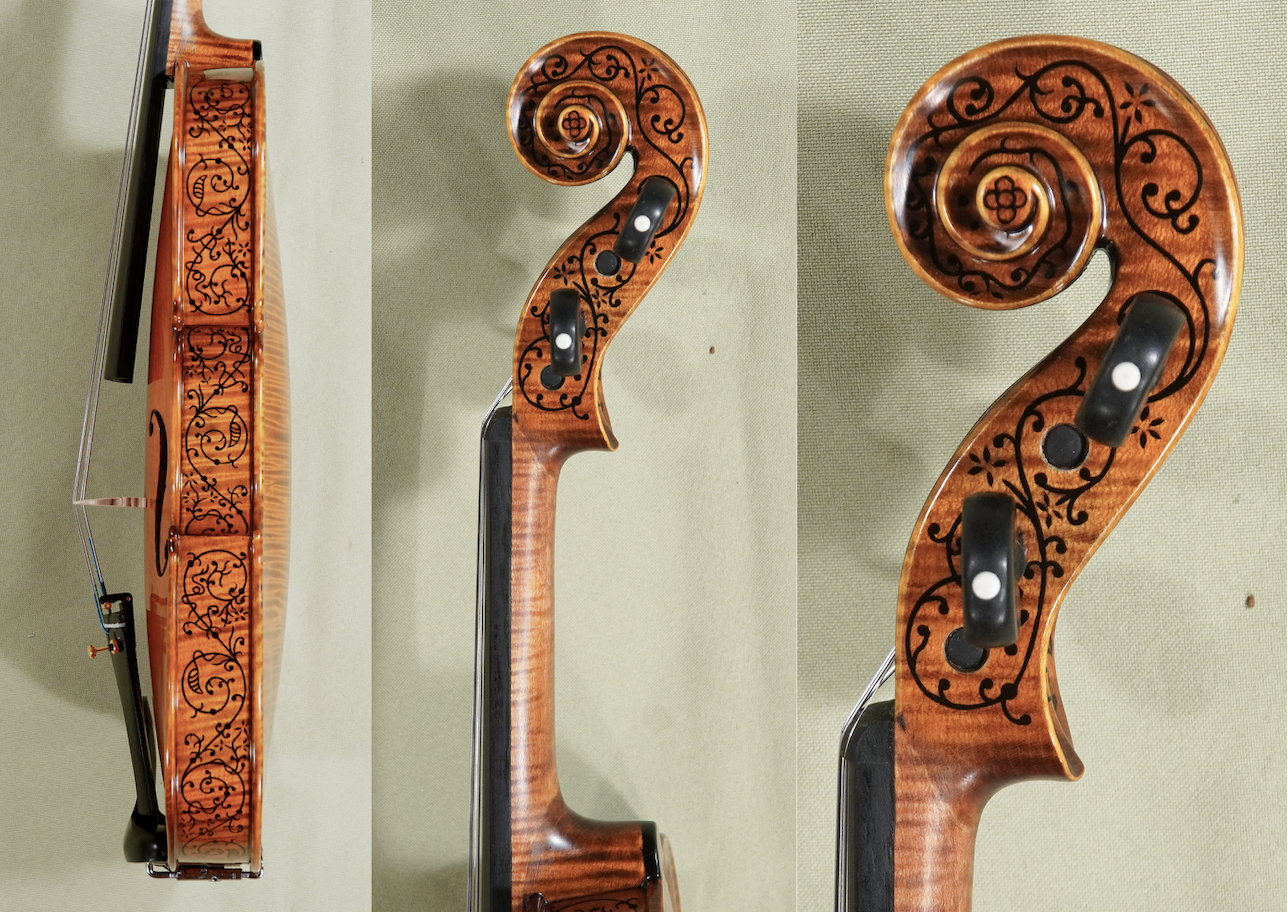
| Artistic Design: | Manually Inlayed Decoration |
| Finish: | Oil |
THE ORIGINAL
Around 1679, Antonio Stradivari finished a violin he would not let go of. He was in his mid-thirties, still working close to the Amati tradition, and he covered the instrument in ornament: channels cut into the head and the ribs and filled with ebony mastic, drawn as a running vine of leaves, flowers and scrollwork that climbs the pegbox and runs almost into the eyes of the scroll. Around the edges of the belly and the back he set two rows of purfling and threaded between them a chain of tiny ivory circles alternating with engraved ivory diamonds — two hundred and forty separate pieces on the back alone.
It is one of roughly ten decorated Stradivari instruments to survive, and the one most often called the finest. Roger Hargrave, who examined it closely for The Strad, called the inlay on the head and ribs “of staggering fluidity” and the most delicately inlaid he had seen; the Hill brothers judged the symmetry of the head and the design of the f-holes to be ahead of anything else Stradivari was making at the time.
He kept it for fifty-five years. In 1734, at the age of ninety, he finally sold it to Sir Samuel Hellier of Wombourne in Staffordshire, who had travelled to Cremona to buy it, for £40 — and the violin has carried that English family’s name ever since. It stayed with the Helliers until around 1880, passed through the Hill firm and a series of collectors, and was offered at Christie’s in 2022 against an estimate of £6–9 million. For years it has been on loan to the Museo del Violino in Cremona, where it can still be seen.
GLIGA’S INTERPRETATION
The Gliga “Hellier” takes the original as its starting point rather than as a blueprint to be copied line for line. The ribs and the scroll are followed faithfully: the same dense, unbroken arabesque winds along each rib panel, climbs the pegbox and turns with the volute, closing at the eye — the passage Hargrave singled out on the original, and the part that asks the most of the hand that draws it.
On the top and the back, the approach changes. Stradivari’s second row of purfling and its ivory chain are set aside; the Gliga keeps a single, conventional purfling line, and answers the original with the same decorative vocabulary held deliberately in reserve — sprays of the identical vine gathered at the corners, at the upper bouts and across the lower back, leaving the flame of the maple and the grain of the spruce to carry the rest. The ornament frames the instrument rather than covering it: a restrained reading of a famously lavish violin, and one that keeps the eye moving between the decoration and the wood beneath it.
The decoration follows the original’s method as well as its pattern — ebony powder bound with glue, worked by hand into the surface of the wood, exactly as the vine on the 1679 violin was made. Beneath it is flamed maple and resonance spruce from the Carpathian mountains, the forests Reghin has drawn on for generations: selected for figure and grain, then left to air-dry for twelve years before a knife touches it. Wood is the one thing in a violin that cannot be corrected later, and an instrument that takes this many hours to decorate is only worth building on tonewood that will still be holding its voice in a hundred years. Carved, decorated and varnished by hand in the Gliga workshop in Reghin, Romania; no two of these decorated instruments come out identical.
SETUP AND STRINGS
The violin is made in Romania and set up here in Vancouver, by a local luthier, before it is sold — bridge, soundpost and fingerboard adjusted, and the instrument strung with Pirastro Evah Pirazzi Gold: a modern synthetic multifilament core wound in gold on the G, silver on the D, aluminium on the A, and steel on the E. Pirastro make this set in medium gauge only, at a medium to medium-high tension: enough pull to drive the top and give the violin its projection, without the stiffness under the left hand that a heavy-gauge string brings.
SPECIFICATIONS
- Back, ribs and scroll: book-matched flamed maple from the Carpathian mountains
- Top: close-grained resonance spruce from the Carpathian mountains
- Seasoning: air-dried 12 years before carving
- Decoration: hand-applied ebony decoration (ebony powder and glue), after the original’s technique
- Fittings: ebony
- Strings: Pirastro Evah Pirazzi Gold, medium gauge (gold-wound G)
- Made in: the Gliga workshop, Reghin, Romania, 2024
- Set up in: Vancouver, by a local luthier, before sale
SOURCES
The account of the 1679 original above is drawn from the following, where the instrument can also be seen in detail:
- Roger Hargrave, “Antonio Stradivari ‘Hellier’ 1679”, The Strad — a maker’s close examination of the inlay, its depth and technique.
- Tarisio, Cozio Archive — catalogue entry for the 1679 “Hellier”, with measurements and provenance.
- Friends of Stradivari — on the decorated instruments, including the 1677 “Sunrise” and the 1679 “Hellier”.
- The Strad — on the 2022 sale, the Hellier family purchase of 1734, and the ornament.
- Christie’s — photographs of the 1679 “Hellier” and an account of its history, from the 2022 sale.
The Gliga “Hellier” is an instrument of the Gliga workshop’s own design, inspired by the 1679 original. It is not a copy of it, and it has no connection to the owners of the Stradivari violin or to the institutions listed above.
All orders will be processed immediately and shipped out to you within 24 hours. Orders received on Friday or over the weekend will be mailed out on Monday.
All our instruments come with a 7-day trial period. The trial period begins on the day of delivery. You may return all items you purchased within 7 days of delivery. A refund will be processed promptly, as soon as the items reach our office in Vancouver. The items must be in the same condition in which they were when received.